Umbria

Umbria is the only region of Italy without a coastline. It has no city with an airport of its own, no stretch of motorway wider than two lanes, and no stretch of tourism industry that is anything like Tuscany next door. What it has is hill towns — more than 150 of them — set on ridges above olive groves and oak woods, built in the pink-and-grey local limestone the Umbrians have used since before Rome. It has the tomb of Saint Francis, the best black truffles in Italy, and a wine (Sagrantino di Montefalco) that can go fifteen years in the cellar and still have another decade in it. It’s been called “the green heart of Italy” for so long that the phrase has become a tourist slogan. It’s actually green for reasons. Most of the region is still forest, still agriculture, still small, slow and surprisingly unvisited.

I spend more time here than anywhere else in central Italy. Tuscany gets the tour buses; Umbria gets the people who came for Tuscany twenty years ago and worked out that next door was quieter, cheaper, and had better food. Whether or not the last two are still true is debatable. The first one still is.

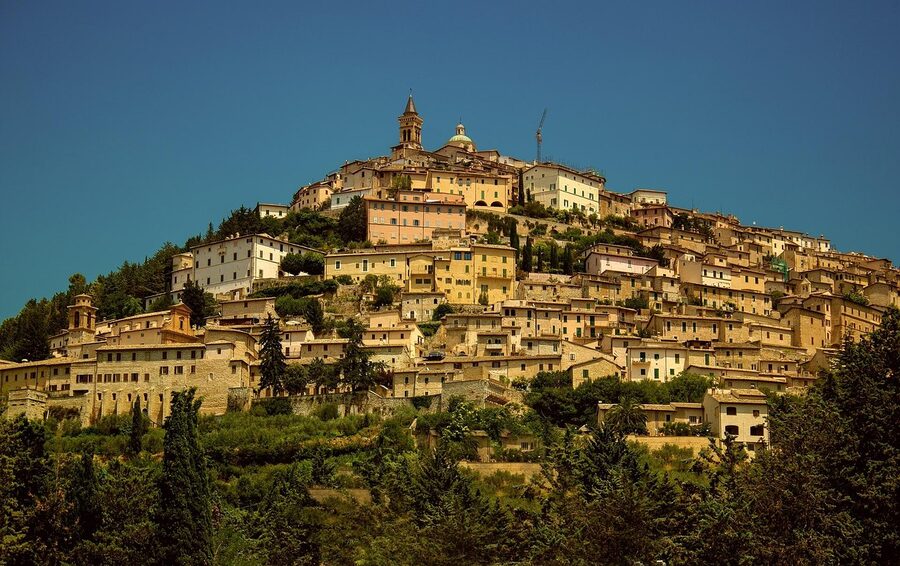
Panoramic view of Umbrian countryside near Trevi with olive groves, hills and the Valnerina beyond
The Umbrian interior in late afternoon — this is Trevi, perched on its ridge above the Valnerina, and the hills beyond are the Monti Sibillini. Roughly 85% of Umbria looks like this.

What Umbria actually is

The region is small. About 8,500 square kilometres, half the size of Wales, and a population of around 870,000 — most of whom live in the two provincial capitals (Perugia and Terni) and a handful of mid-size towns (Foligno, Città di Castello, Spoleto). Geographically it’s a landlocked bowl in central Italy, bordered by Tuscany to the west, Marche to the east, Lazio to the south, and with the upper Tiber running north-south down the western side. The terrain is mostly hills — the central Apennines form the eastern border and drop down gradually to valleys in the middle. The highest point is Monte Vettore on the Marche border at 2,476 metres.

The Umbrians were a pre-Roman Italic tribe — the name of the region is the oldest in Italy, predating the arrival of the Etruscans to the west and the Romans in general. The Etruscans built Perugia and Orvieto as hilltop strongholds; the Romans Romanised the whole region from the 3rd century BC. In the Middle Ages, Umbria became part of the Papal States and stayed there for almost a thousand years. It joined unified Italy in 1860. The Papal centuries are the reason the region has so many tight little walled towns with so many churches: every commune needed a cathedral, every cathedral commissioned painters, and the painters in Umbria were unusually good. Perugino trained Raphael; Pinturicchio frescoed the Baglioni chapel in Spello; Pier Francesco Fiorentino, Giotto’s workshop, Simone Martini — they all worked here.

Getting there

Umbria has one small airport — San Francesco d’Assisi (PEG), near Perugia — with a handful of Ryanair flights from London Stansted, Brussels and Bucharest, plus a seasonal Vienna link. It’s tiny. For most arrivals, the practical airports are Rome Fiumicino (2h30 drive to Perugia; two direct daily coach services) or Florence Peretola (2h drive to Perugia).

By train, the region is served by the Rome-Florence and Rome-Ancona mainlines and a number of regional branches. Perugia is about 2 hours from Florence, 2h15 from Rome, 3h30 from Milan. Assisi is 30 minutes from Perugia on local train. Orvieto is on the Rome-Florence mainline (1h15 from Rome, 2h from Florence). Spoleto is on the Rome-Ancona line.

The real way to see Umbria is by car. The region is a network of hill towns that are five to twenty kilometres apart, each on its own ridge, connected by minor roads that wind through the valleys. A three- or four-day driving loop from Perugia → Assisi → Spello → Bevagna → Montefalco → Spoleto → Orvieto → Todi → Perugia is one of the most rewarding circular drives in Italy. Rent a car at Perugia station or at your arrival airport.

The regional heavy hitters, in one minute each

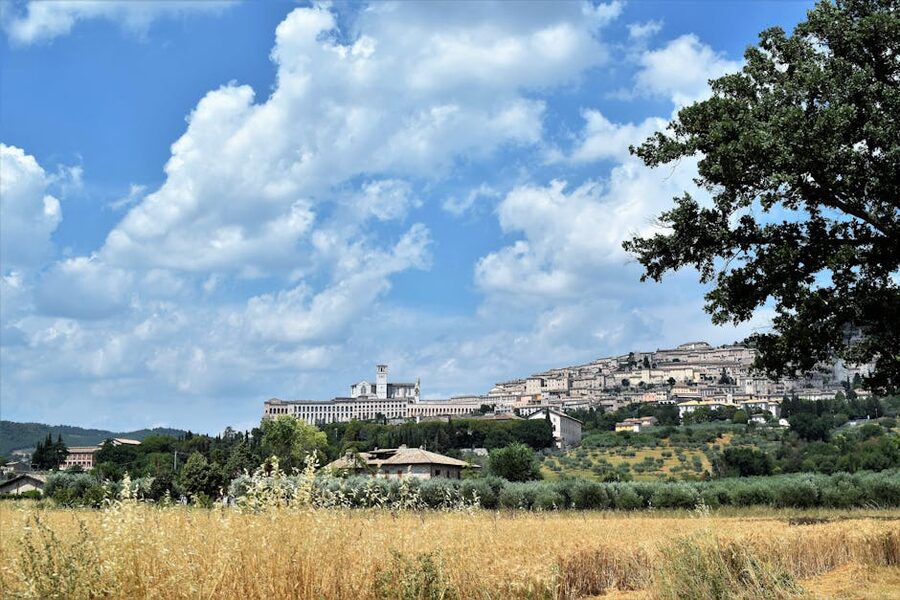
The Basilica of Saint Francis in Assisi on a sunny day, with the medieval town below the hillside
The Basilica of Saint Francis at Assisi — upper church, lower church, and the crypt where the saint is buried. The Giotto fresco cycle covering the upper church walls is one of the most consequential works of art in medieval Europe.

Assisi is the famous one. The town has been a pilgrimage destination since 1228, when the basilica was started over the tomb of Saint Francis two years after his death. The upper church contains the Giotto fresco cycle — 28 scenes from Francis’s life, painted around 1297-1300 — that changed European painting. The lower church has frescoes by Cimabue, Simone Martini and Pietro Lorenzetti. The town itself is small, walled, preserved, and packed most days between 10am and 5pm. Come in the early morning or stay overnight. The higher basilica of Santa Chiara has the relics and habit of Saint Clare, Francis’s companion, and is often skipped — don’t. The Eremo delle Carceri, Francis’s forest hermitage, is a twenty-minute drive into the woods above Assisi and is the most atmospheric Franciscan site of all. For Saint Francis’s context within Umbria, see the forthcoming guide in Famous Italians.

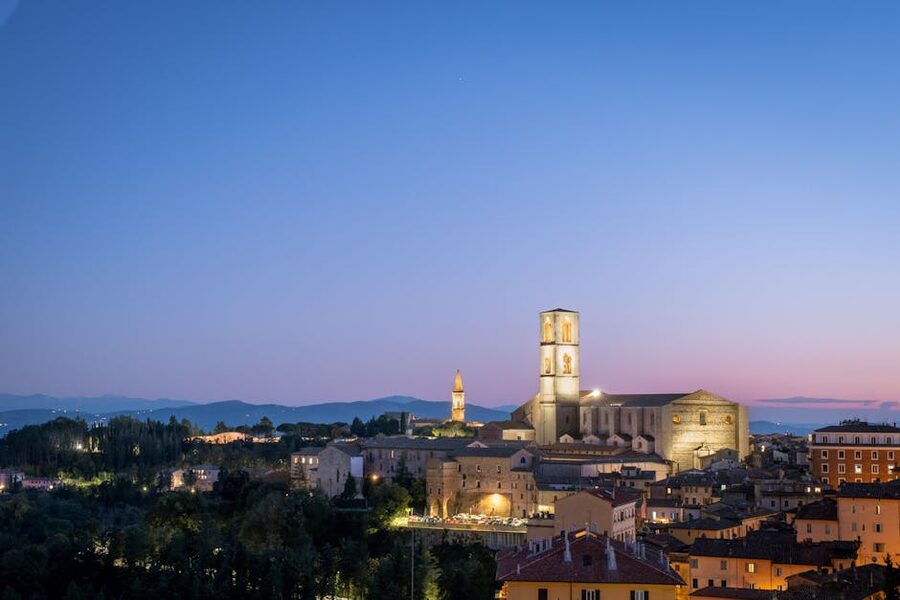
Perugia at twilight showing the medieval skyline, San Domenico church and the university hilltop position
Perugia at blue hour — the regional capital, built on five hills that were originally Etruscan. The skyline you see is entirely medieval; the university down the hill is not.

Perugia is the capital — 160,000 people, a university town (the Università per Stranieri teaches Italian to international students; the general Università di Perugia was founded in 1308), and the region’s most sophisticated city. The old town is on a hilltop above the modern commercial outskirts, reached by a set of escalators through the 16th-century Rocca Paolina — a subterranean papal fortress that was built directly on top of the medieval town and is now a public passageway. The main square, Piazza IV Novembre, is one of the finest in central Italy, anchored by the striped-marble Fontana Maggiore (1275) and the gothic Palazzo dei Priori which houses the Galleria Nazionale dell’Umbria — the best painting collection in the region, with major Duccio, Piero della Francesca, Perugino and Pinturicchio. Perugia hosts Umbria Jazz every July, one of the world’s top jazz festivals, and is where Chocolate Perugina (Baci) is made. Worth two nights on its own.

Orvieto — see the full guide.

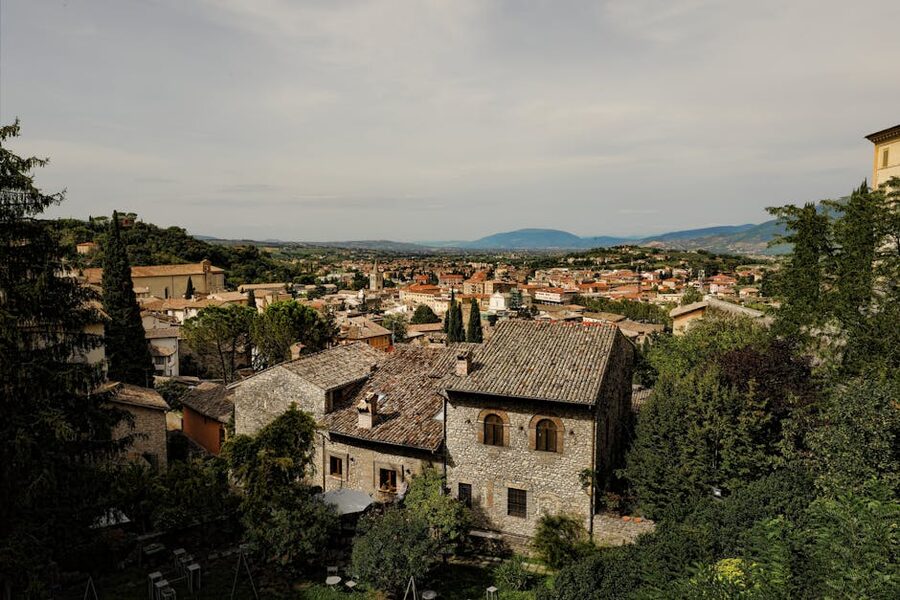
Spoleto medieval town with historic architecture and lush green hills surrounding
Spoleto from above — a walled medieval town on a hillside, with the imposing 14th-century Rocca Albornoziana fortress at the top and the cathedral below.

Spoleto is the southern jewel. A hilltop walled town known historically as the Papal residence on the way down from Rome (and before that, the capital of the Lombard Duchy of Spoleto for five centuries). Two standout sights: the Rocca Albornoziana (14th-century fortress, now a museum of the Duchy), and the 14th-century Ponte delle Torri — a 76-metre-high bridge-aqueduct spanning the gorge that divides the town from Monteluco hill, on which the medieval Spoletans put up the city’s water supply. The cathedral has a Filippo Lippi fresco cycle in the apse — Lippi died here while painting it, supposedly of poison administered by the family of a nun he had seduced (a story that is less solid than the fresco). Every summer, the town hosts the Festival dei Due Mondi — the Spoleto Festival of Two Worlds — an international arts festival founded in 1958 that brings opera, theatre, and orchestral music into the streets for three weeks of June-July.

Gubbio, in the far north of the region, is the prettiest of Umbria’s walled hill towns — a sheer slope of pale limestone houses climbing the side of Monte Ingino, with the massive Palazzo dei Consoli dominating the skyline. It’s the home of the Festa dei Ceri on 15 May — a medieval race in which three teams carry three 4-metre wooden “candles” uphill to the church of Sant’Ubaldo, unchanged since at least the 12th century. In any town that size anywhere else in Europe there would be queues for tickets; here, the whole thing is free and you stand in the piazza.

Todi — another hilltop town, smaller, quieter, with a perfectly intact medieval square (Piazza del Popolo) and a much-photographed church, Santa Maria della Consolazione, just outside the walls.

The smaller hill towns

Beyond the five heavy hitters, Umbria has a dozen smaller walled towns each worth an afternoon. The arc from Assisi south and east to Spoleto is the most rewarding half-day drive in the region. In order:

Spello — right below Assisi on the flat, medieval Roman-founded, famous for its floral displays (the Infiorate di Spello) at Corpus Christi in June. The church of Santa Maria Maggiore has a Pinturicchio fresco cycle that almost nobody queues for.

Bevagna — a smaller walled town, Roman-founded on the Via Flaminia, with two intact Romanesque churches on a single square and the best-preserved set of medieval artisan workshops in Italy (the Gaite del Mercato, open in summer).

Montefalco — “the balcony of Umbria” — a hilltop town that looks down over the whole Valle Umbra, with a 16th-century piazza and the base of operations for the region’s great red wine, Sagrantino di Montefalco. Do an afternoon at Arnaldo Caprai, the producer that almost singlehandedly revived the variety in the 1990s.

Trevi — one of the steeper ridge towns; the Museo della Civiltà dell’Ulivo is an oddly fascinating olive-culture museum and the town produces one of Italy’s best single-variety olive oils.

Foligno, Nocera Umbra, Spello again — the Valle Umbra towns, each a rewarding detour.

Norcia, east of Spoleto in the Sibillini foothills, is the home of Italian cured pork — norcineria is both the local word for butcher’s shop and the national term for professional charcuterie. Norcia was the birthplace of Saint Benedict in 480 AD. The town was very badly damaged by the earthquakes of August-October 2016; some buildings are being rebuilt, some remain in scaffolding. Go, spend money, and respect the reconstruction.

The natural assets

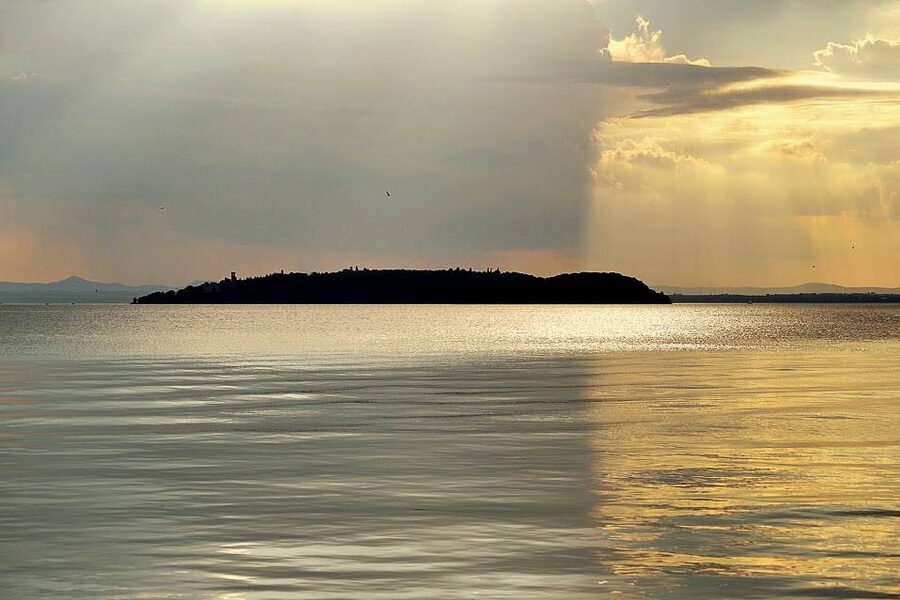
Lake Trasimeno at sunset with silhouetted islands and fishermen's boats
Lake Trasimeno at sunset — Italy’s fourth-largest lake, largely overlooked by tourists heading north to Garda or Como. The three islands (Maggiore, Minore, Polvese) each have a ferry service and their own small character. Photo by Mario.coffa / Wikimedia Commons (CC BY-SA 4.0)

Lago Trasimeno is Italy’s fourth-largest lake — 128 square kilometres, shallow (6 metres deep on average), three islands — and barely on the tourist radar because it gets overshadowed by Lake Garda to the north. Which is a shame, because the three lake villages (Castiglione del Lago, Passignano sul Trasimeno, Tuoro) are picturesque in a quiet, minor-Italian way, and the fish menu — a carp-and-eel-heavy freshwater tradition unique to Umbria — is interesting. Hannibal famously destroyed a Roman army here in 217 BC (the Battle of Lake Trasimene), and there are still small archaeological markers along the lake shore at Sanguineto and Ossaia (“the bloody place” and “the bone place” — Romans knew where to put a memorial).

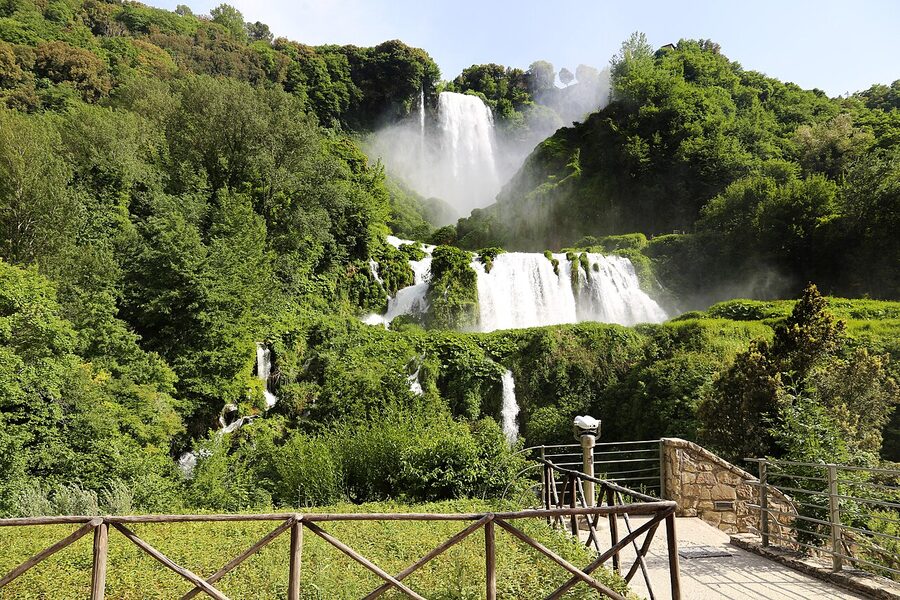
The Marmore Waterfalls in Umbria, one of the highest man-made waterfalls in the world, cascading through lush forest
The Cascata delle Marmore — 165 metres tall, three cascades, man-made by the Romans in 271 BC (engineer Manius Curius Dentatus), still running. The water is released on a schedule; check times at the visitor centre. Photo by Sailko / Wikimedia Commons (CC BY-SA 4.0)

The Cascata delle Marmore, near Terni, is one of the oldest engineered landscapes in Europe — a 165-metre waterfall in three tiers, built by the Romans in 271 BC to drain a stagnant upland plain into the river Nera. It has been running ever since. The flow is now controlled and released on a schedule (typically two or three times a day, coordinated with the downstream hydroelectric plant) — check the official timetable before you visit or you’ll arrive at a modest trickle. €12 entry to the park, various walking trails around and beneath the falls, a small café.

The Monti Sibillini National Park spans Umbria and Marche on the east side of the region (see the Marche guide for the north side of the park) — high Apennine peaks, the Piano Grande wildflower plain, and the hermitage traditions that go back to medieval Christianity. Good walking, good skiing in winter, quiet villages still recovering from the 2016 earthquakes.

Food and wine

Umbrian food is inland-Italian food with an unusual concentration of meat, truffle, and game — the region’s relative lack of access to the sea meant the food tradition tilted toward what the land provides. Five things to eat and one to drink:

Tartufo Nero (black truffle) — Umbria produces about two-thirds of Italy’s commercial black truffle output. The best is the Tuber melanosporum — the black winter truffle — harvested November to March around Norcia and Spoleto. In season, every restaurant has it on pasta and eggs. Out of season, the summer black truffle (scorzone) is cheaper and lighter. Don’t trust truffle sauces unless you’ve checked the supplier — a shocking amount of “truffle” in Italian restaurants is truffle oil, which is synthetic.

Norcineria — the cured-pork tradition of Norcia. Capocollo, coppa di testa, mazzafegati (liver sausages), lonza, prosciutto of wild boar. Sold in norcinerie (butchers) across the region, each with its own family recipe. Best combined with a slab of pecorino di fossa and a glass of Sagrantino.

Porchetta — the boneless roast pig of central Italy, seasoned with herbs and salt, cooked whole for hours, served cold in slices on a crusty roll. Umbrian porchetta is characteristically heavily herbed with wild fennel. Every weekly market has a porchetta stand. Bevagna’s is particularly good.

Torta al Testo — the Umbrian flatbread, cooked on a testo (cast-iron disc) on the open hearth, 20cm across, puffed and bubbled on top, served split and stuffed with any of the above. The Perugia version is about 2cm thick; the Assisi version is thinner and rolled.

Strangozzi / Stringozzi — the local thick hand-rolled pasta, square-cut, typically served with black truffle (strangozzi al tartufo nero) or with a tomato and garlic sauce (strangozzi all’etrusca).

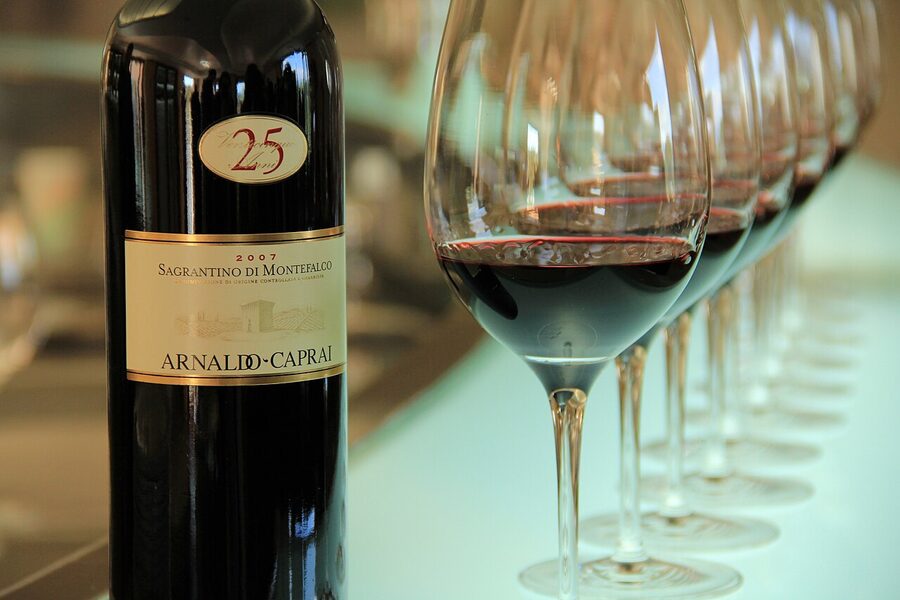
A glass of Sagrantino di Montefalco dark red wine with a Montefalco vineyard in the background
Sagrantino di Montefalco — one of the most tannic grape varieties in the world. A good bottle needs at least eight years in the cellar before it’s drinkable and can age for thirty. Around €25-50 from the top producers. Photo by Michela Simoncini / Wikimedia Commons (CC BY 2.0)

Sagrantino di Montefalco DOCG — the region’s great red. Made from the indigenous Sagrantino grape grown on the hills around Montefalco, it’s one of the most heavily tannic wine grapes in the world, with polyphenol levels around 4% (most red wine grapes are around 1-2%). The historic tradition was to make a sweet passito wine from dried Sagrantino grapes; the dry version is a 20th-century innovation. Needs cellar time — ten years before you open it is a reasonable minimum. Top producers: Arnaldo Caprai, Tabarrini, Romanelli, Perticaia.

Also: Orvieto Classico (a dry white on the Grechetto grape, light and minerally — the traditional wine of the Papal court), Torgiano Rosso Riserva DOCG (Sangiovese-based red from Lungarotti, north of Perugia), and the local dessert wines Sagrantino Passito and the lesser-known Vin Santo di Montefalco.

When to visit

May, June, September and early October are the sensible windows for Umbria — 20-27°C, hills green, crowds manageable. July and August are hot (30-35°C on the bad days) and all the hill towns struggle with air flow; the advantage is the summer festival calendar (Umbria Jazz in July, Spoleto Festival in June-July, Todi Festival in late August). Winter is cold, grey and atmospheric — the best time for truffles, the cheapest time for the agriturismo network, and the moment to see Assisi without a queue at the basilica. Do not come between 23 December and 6 January if you want to drive — the hill towns become impassable with festival visitors.

Dates worth planning around:

  • Festa dei Ceri, Gubbio, 15 May — the Umbrian medieval race
  • Infiorate di Spello, Corpus Christi weekend (May-June) — the floral carpets
  • Spoleto Festival of Two Worlds, late June-July — international arts festival
  • Umbria Jazz, Perugia, second week of July — jazz festival
  • Calendimaggio, Assisi, first weekend in May — medieval re-enactment
  • Black truffle markets, Norcia, late February and early March — the annual truffle festival

How to put it together

Short trip (3-4 days): base in Perugia or Assisi, do Perugia + Assisi + Spello + Orvieto day trip.

Standard trip (7 days): Perugia (2 nights), Assisi (2 nights), southern loop via Spoleto/Montefalco/Bevagna (2 nights in Spoleto), Orvieto on the way out (1 night). A car for at least four of the seven days.

Long trip (2 weeks): add Todi, Gubbio, Città di Castello in the north, a detour to Norcia and the Piano Grande (spring/summer only), and a couple of days at Lake Trasimeno.

Individual city guides: Orvieto, Bevagna, Spello, Foligno, Nocera Umbra as they come online. For the Francis circuit across the region (Assisi, San Damiano, the Porziuncola, the Eremo delle Carceri, Montefalco, Piandarca, Gubbio, La Verna, Greccio) see Saint Francis across Umbria. The region is best understood one town at a time, over several visits, with a map and a willingness to drive slowly.

Nocera Umbra

Nocera Umbra is the Umbrian hill town behind the mineral water. Beyond the bottling plant: a Lombard necropolis, a cathedral with the incorrupt body of Saint Raynald, a Franciscan pilgrim geography, and a painstaking restoration after the 1997 earthquake.

Bevagna

Bevagna is a walled town of five thousand people twenty kilometres south of Assisi, on the flat of the Valle Umbra. It does not appear in most international guidebooks. It has never had a railway station. It has one traffic…

Orvieto

Orvieto sits on top of a cliff. The cliff is a single block of volcanic tufa, 300 metres across, rising 150 metres above the surrounding countryside with nearly vertical sides. The Etruscans built a city on the flat top in…