
Tuscany
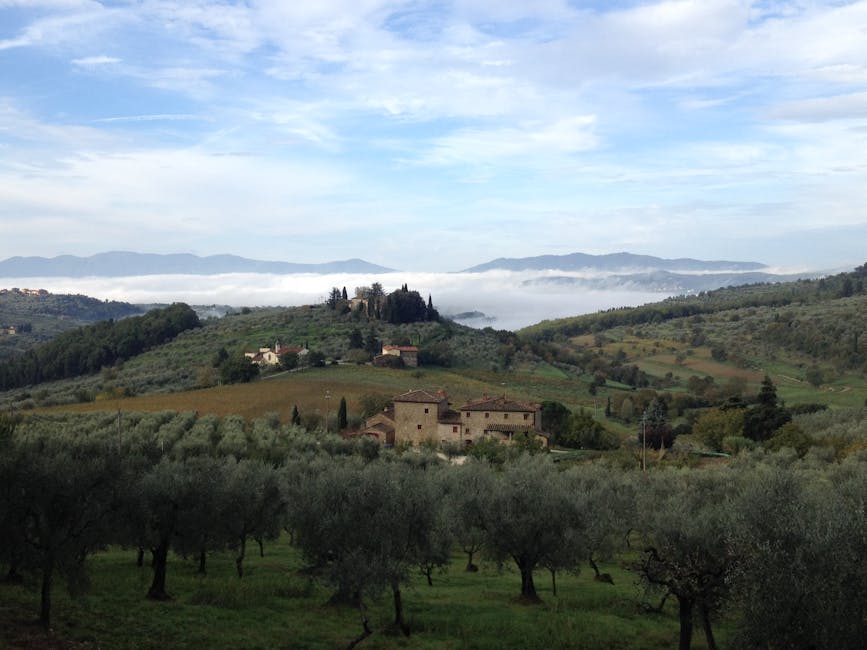
Tuscany is the Italian region you already have a picture of. Cypresses lining a ridge road. A Renaissance city with the world’s best art gallery. A thirteenth-century walled town where nothing has been built since 1280. A bitter dark red wine that was poured at Michelangelo’s table and still tastes like it does now. A bowl of ribollita soup that is cheaper than a supermarket lunch and better than almost any dinner. This is Tuscany. It contains more UNESCO World Heritage Sites than any other region in Italy, more famous artists per acre than anywhere else in Europe, and the single most visited small city in the world (Florence). You already knew that. The question is what to do about it.
This hub is organised around an assumption: most people coming here are on a tight schedule, want to see the headline acts, but would also like not to queue for eight hours or eat at a place called Trattoria Bella Italia Pizza Since 1947. The headline acts earn their reputation. The secondary circuit — Lucca, Arezzo, the smaller hill towns, the Maremma coast — is less pressured and often better-value. Below: what’s worth what, when to come, and how to spend time once you’re here.
What Tuscany actually is
Geographically the region runs about 250 kilometres north-south, from the Apennine ridge at the Emilia-Romagna border down to the Lazio border near Rome, and about 200 east-west, from the Tyrrhenian coast inland to the Arezzo valley. The terrain is almost entirely hills: only 8% of Tuscany is flat, and most of the flat ground is the coastal Maremma and the Arno river valley west of Florence. The highest point is Monte Prado in the Apuan Alps (2,054m); the coast has two islands (Elba and Giglio) and a dozen smaller ones.
Ten provinces: Florence, Siena, Pisa, Lucca, Arezzo, Grosseto, Livorno, Pistoia, Prato, Massa-Carrara. Population about 3.7 million. The regional economy runs on three engines — tourism, light manufacturing (textiles in Prato, leather in Florence, Vespas in Pontedera), and agriculture (mostly wine, olive oil, wheat, and the Chianina cattle that becomes bistecca alla fiorentina).
Historically this was Etruria — the civilisation of the Etruscans from the 9th century BC onwards, speaking a non-Indo-European language, making bronze and terracotta, leaving one of the most enigmatic archaeological footprints in Europe. Rome absorbed the Etruscans by the 2nd century BC. The Middle Ages gave the region its defining shape: independent city-republics (Florence, Siena, Pisa, Lucca, Arezzo, Volterra, Pistoia, Prato) that spent the 11th to 15th centuries building the commercial wealth that funded the Renaissance. The Medici family consolidated Florence and most of Tuscany in the 15th century; their rule ran until 1737. The Grand Duchy of Tuscany passed to the Habsburg-Lorraine dynasty, then to unified Italy in 1860.
Seven Tuscan sites are on the UNESCO list: the historic centres of Florence, Siena, Pisa, San Gimignano, Pienza, the Val d’Orcia landscape, and the Medici Villas and Gardens (12 of them). No other Italian region has as many.
Getting there
Tuscany has two airports. Florence Peretola Amerigo Vespucci (FLR) is small, close to the centre, with short-haul European flights. Pisa Galileo Galilei (PSA) is larger, with more international routes including long-haul and low-cost carriers. Pisa is 80 km from Florence, 45 minutes by train.
By train: the Milano-Roma high-speed line stops at Florence (Santa Maria Novella station), 1h30 from Milan, 1h30 from Rome. Regional services extend to Siena, Arezzo, Pisa, Lucca. Siena is 1h15 from Florence by bus, slightly slower by train (change required).
By car: the A1 runs down the centre of Italy through the region (Florence-Rome-Naples), the A11 connects Florence-Pisa, the A12 runs the coast. Car rental is the right answer for the smaller hill towns and the rural wine regions; the big cities are better reached by train and walked.
Florence
Florence (Firenze) is the region’s headline act and the most-visited mid-sized city in the world. Population 360,000 within the comune, 1.5 million in the metropolitan area, about 16 million visitors annually. The historic centre — inside the old city walls, now mostly Medicean boulevards — is walkable in two hours. Inside it: the Uffizi (the single greatest collection of Italian Renaissance painting in the world), the Duomo with Brunelleschi’s dome (1420-1436, the biggest self-supported brick dome ever built, still), the Ponte Vecchio (medieval bridge with goldsmiths’ shops above the Arno), the Accademia (Michelangelo’s David), the Palazzo Pitti and the Boboli Gardens, the Bargello (sculpture museum) and half a dozen other one-mile-away sites of global significance.
The key piece of advice: book timed-entry slots months in advance. The Uffizi in summer sells out six weeks ahead. The Accademia (David) sells out sooner. The duomo dome climb needs a separate ticket with its own timed slot. Without advance booking, you will either not get in at all or pay 3x at the door for a same-day slot from a reseller. The Florence Card (€85, 72 hours, covers 60 museums) makes sense if you’re doing five museums or more; otherwise, book individually via the official sites.
A full Florence guide is in preparation — see the forthcoming Florence hub.
Siena
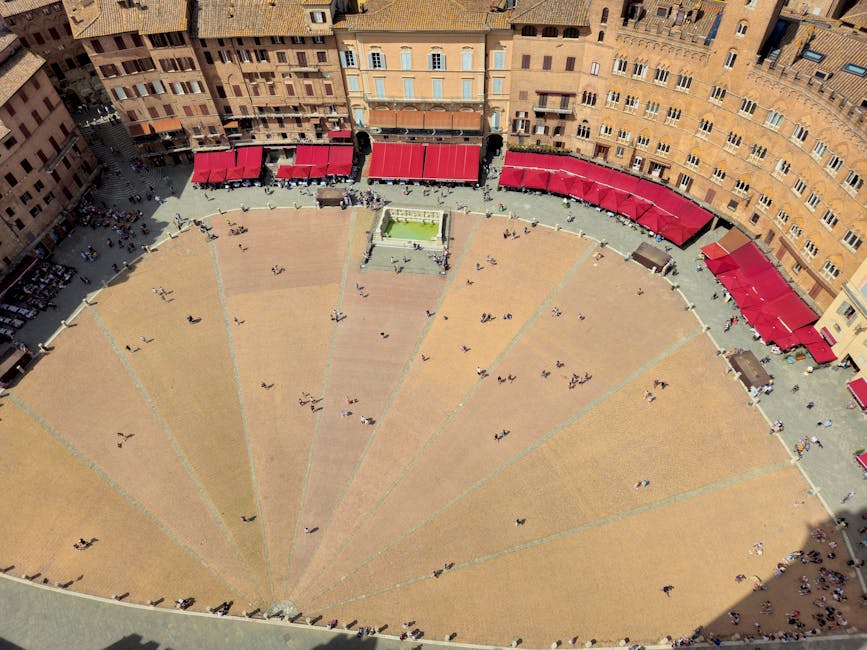
Siena is Florence’s old rival — population 54,000, fortified medieval hill town, still divided into the seventeen contrade (neighbourhood districts) that compete in the Palio horse race twice a year. The Piazza del Campo is one of the great European squares; the Palazzo Pubblico on its south side holds the Sala dei Nove with Lorenzetti’s 1338 Allegory of Good and Bad Government frescoes (the earliest surviving large-scale secular landscape painting in European art — stand in front of the Effetti del Buon Governo panel and understand that sixty per cent of Western political theory since follows from it). The Duomo is Gothic, black-and-white striped, with a polychrome marble floor normally covered but uncovered for a few months each year. The small-but-essential Pinacoteca Nazionale has the best collection of Sienese 14th-century painting outside Florence.
The Palio itself runs twice: 2 July (dedicated to the Madonna of Provenzano) and 16 August (the Palio of the Assumption). Ten of the seventeen contrade race three times around the Campo — 90 seconds of medieval bareback horseracing, prepared for through a year of contrada dinners, bribes, and tactical alliances. Going is a commitment: the Campo fills from 5pm, the race starts at 7pm, you cannot leave the standing area until it ends, and if you want a seat you paid for it months ago.
For Siena without the Palio: the whole old town walks in two hours. Two nights is plenty. Combine with San Gimignano (35 km) and the Chianti wine road (just north).
Pisa
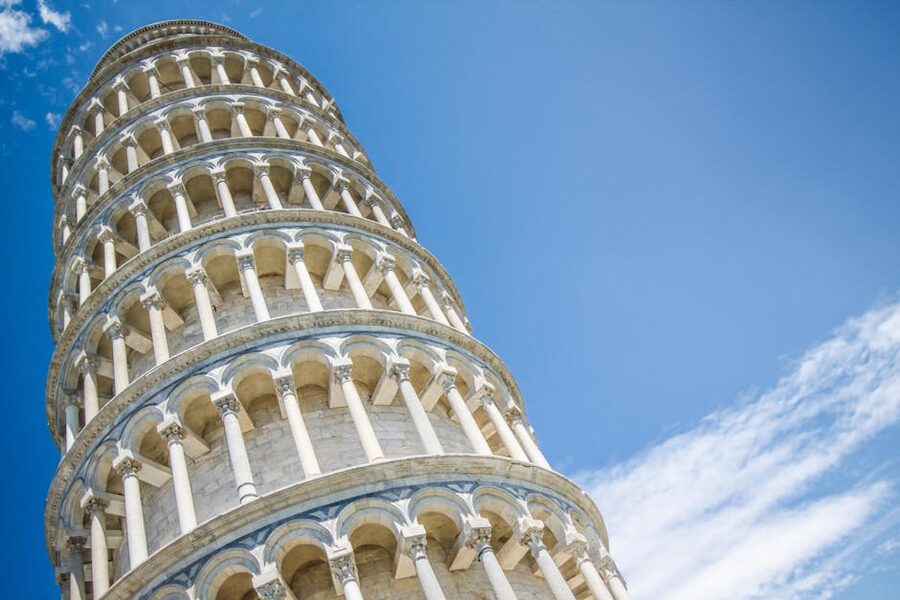
Most people stop in Pisa for a morning to see the Leaning Tower, take the obligatory photo pushing it with their hand, and leave. This is fair. The Campo dei Miracoli — the Field of Miracles — contains the Cathedral, the Baptistery, the Camposanto cemetery, and the Tower itself, all in an ensemble of white marble buildings arranged on an unforested green lawn that is one of the single most photographed medieval architectural compositions in the world. €27 buys you into everything; allow 2-3 hours.
The rest of Pisa, if you have a day, rewards a walk: the Arno riverfront (Lungarno), the small San Paolo a Ripa d’Arno and Santa Maria della Spina riverside churches, the Knights’ Square (Piazza dei Cavalieri) with its Giorgio Vasari-designed façade. Pisa University is one of Italy’s oldest and the student quarter (Borgo) has the best cheap food in town.
Lucca
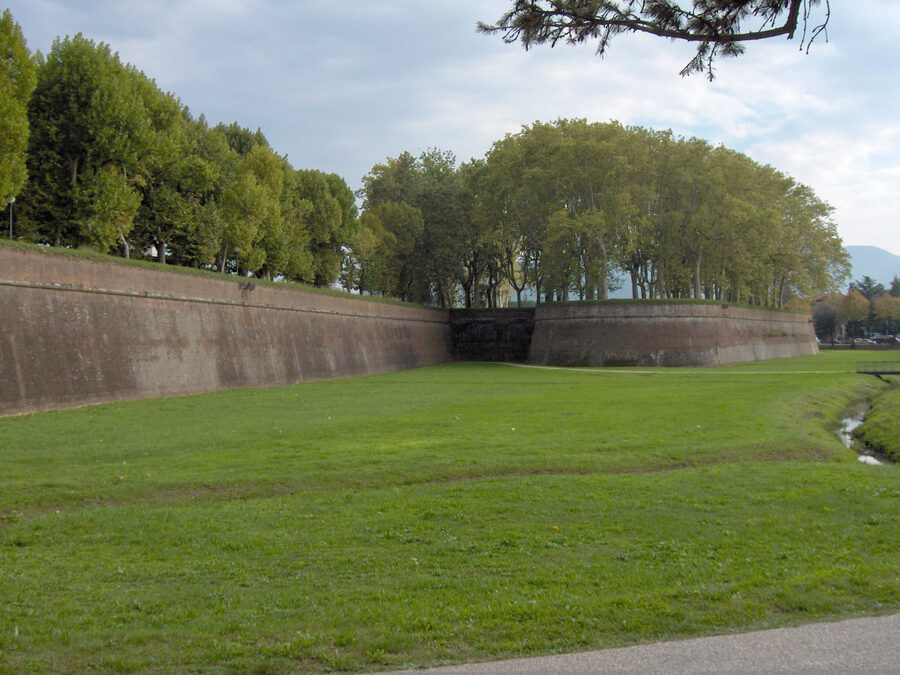

Lucca is my pick for the best mid-size city in Tuscany. Population 90,000, walled, flat (unlike most of the region), and walkable in a way Siena — with its steep streets — isn’t. The 4-kilometre Renaissance city walls are the defining feature: finished in 1650, never used for defence, and in the 1820s converted into a public promenade that runs continuously on top of the ramparts for the full circuit. You can walk it in an hour, cycle it in 20 minutes (rent a bike at Porta San Donato), and it gives you the best city perspective in Tuscany.
Inside the walls: the Piazza dell’Anfiteatro (a piazza built on the oval footprint of the Roman amphitheatre — the curving buildings still trace the arena shape), the Duomo di San Martino (Romanesque, with the Volto Santo crucifix and the tomb of Ilaria del Carretto by Jacopo della Quercia), the Romanesque façade of San Michele in Foro, and the Torre Guinigi — a medieval brick tower with full-grown oak trees growing out of the top (genuinely, not a joke; climb it for €5 and €5 of view).
Lucca was the birthplace of Giacomo Puccini (1858); the small museum on Corte San Lorenzo is in his family home.
San Gimignano, Pienza, Montepulciano and the Val d’Orcia
.jpg)
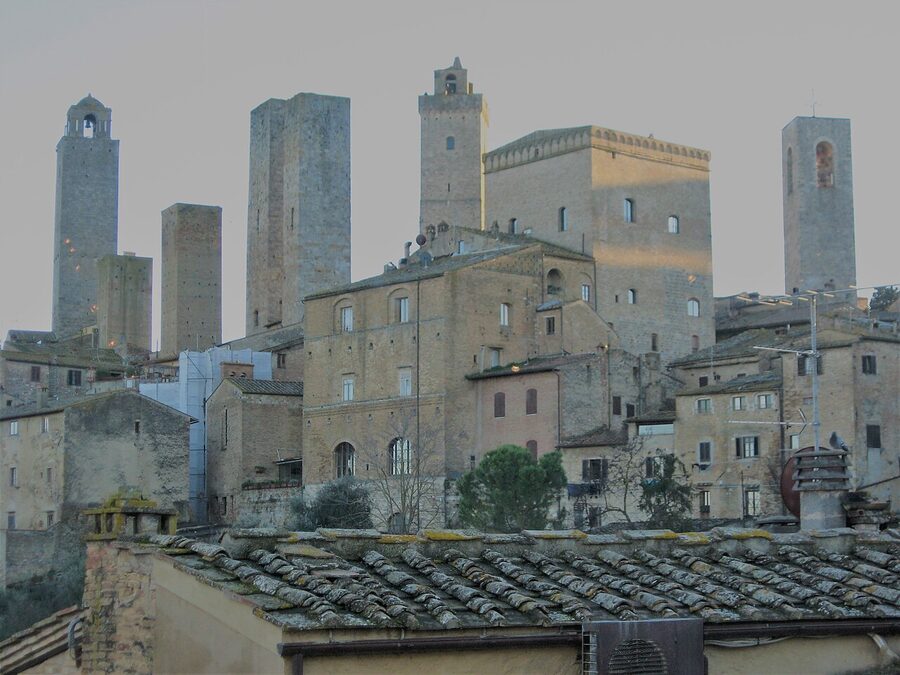
San Gimignano is the “city of beautiful towers” — a small walled hilltop town in Siena province with fourteen surviving medieval towers from an original peak of 72. UNESCO-listed. Tourist-saturated in the middle of the day (every coach tour from Florence, Pisa and Siena stops here); stay overnight if you can, because the town after 6pm is unrecognisably quiet. The Collegiata (cathedral) has fresco cycles by Ghirlandaio and Lippo Memmi. The Vernaccia di San Gimignano — Italy’s first DOC-designated wine, 1966 — comes from the surrounding vineyards; any enoteca in town pours a tasting.
Pienza — population 2,000, entirely Renaissance. Designed as a single architectural composition by Pope Pius II and his architect Bernardo Rossellino between 1459 and 1464, then abandoned as a papal experiment when Pius died. UNESCO-listed 1996. The central square is as pure a piece of Renaissance urbanism as survives anywhere. Famous now for its Pecorino di Pienza — sheep’s milk cheese aged in tuff caves, distinctive, excellent.
Montepulciano — a hilltop town with medieval and Renaissance layers, the local red wine (Vino Nobile di Montepulciano DOCG) sold from the enotecas in the old town. Tasting tour: the Contucci, Avignonesi, and Poliziano cellars are the classic stops.
The Val d’Orcia — UNESCO-listed landscape between Pienza, Montepulciano, Montalcino and San Quirico d’Orcia. The image of Tuscany that you carry in your head — cypresses lining a ridge road, a farmhouse on top of a hill, morning mist in a valley — is probably specifically of the Val d’Orcia. The landscape is protected by specific agricultural-use laws that prohibit building or replanting outside the historic pattern.
Chianti
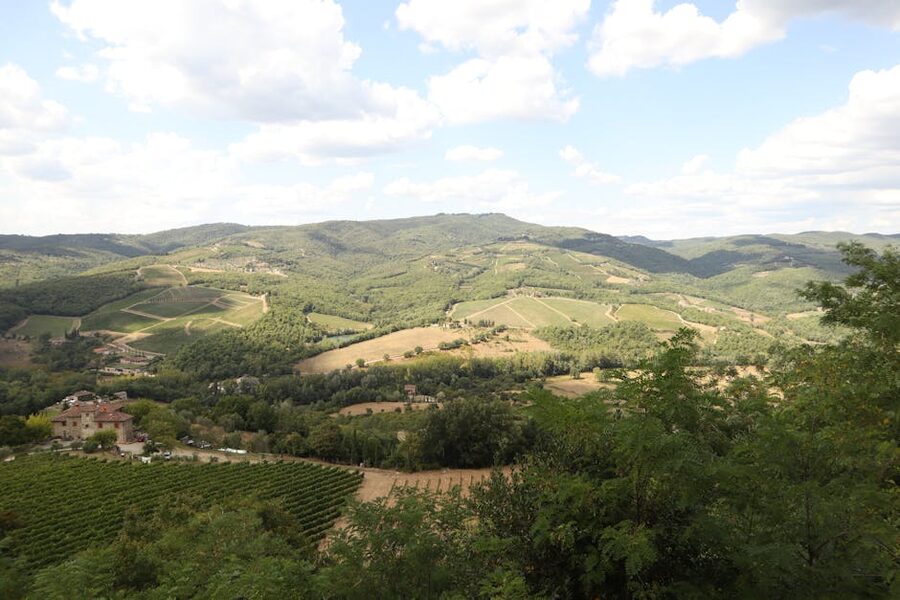
Chianti is a wine region, a landscape, and a mental location. Strictly, Chianti Classico DOCG is the historic 70,000-hectare zone between Florence and Siena, marked by the famous black-rooster emblem (Gallo Nero) on every bottle. Loosely, Chianti is anywhere roughly south of Florence that grows Sangiovese. The difference matters for serious wine drinkers.
Eight villages anchor Chianti Classico: Greve in Chianti (a good base, with a triangular piazza and a weekly market), Radda in Chianti, Castellina in Chianti, Gaiole in Chianti, Panzano, Castelnuovo Berardenga, Barberino Tavarnelle, San Casciano Val di Pesa. Drive between them slowly — the SS222 “Strada Chiantigiana” from Florence to Siena is the scenic route.
For wine: nearly every hillside estate offers tastings (€15-40 for a flight with a snack). Antinori’s Bargino winery (between Florence and Siena, modern architecture, €50 tour with tasting) is the headline commercial experience. Smaller producers worth seeking out: Fontodi, Castello di Ama, Felsina, Badia a Passignano, Castell’in Villa, Monteraponi, Isole e Olena.
See the Chianti hub for the full regional coverage.
Arezzo and Cortona

Arezzo is the eastern anchor of the region, and a small essential stop for one thing: the Bacci Chapel in the Basilica of San Francesco, which contains Piero della Francesca’s fresco cycle The Legend of the True Cross (1452-1466) — one of the five most important fresco cycles of the Early Renaissance, and the one with the shortest queue. €8, by advance reservation only (the cycle is rigorously time-limited, 30-minute slots). Book two weeks ahead minimum.
Arezzo’s other attractions: the unusual sloping Piazza Grande, host to a monthly antiques market (one of the largest in Italy — first full weekend of every month), Vasari’s birthplace, and the Romanesque Pieve di Santa Maria. Arezzo was the setting for Roberto Benigni’s Life Is Beautiful (1997); the prewar piazza scenes were shot in Piazza Grande.
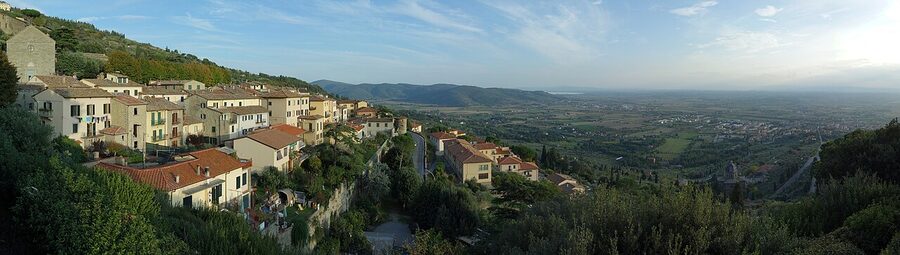
Cortona — 30 km south, a hilltop Etruscan-founded town with panoramic views over the Val di Chiana. Smaller (2,000 people in the walled centre), quieter, now primarily known to anglophones via Frances Mayes’s 1996 memoir Under the Tuscan Sun (which is still on sale in every Cortona bookshop, and whose film was shot partly here). Beyond the book, the town itself has a Luca Signorelli museum, an excellent small Etruscan museum, and a very atmospheric old centre.
The coast — Maremma, Livorno, Elba
The Tuscan coast divides into three stretches:
Versilia (north, Apuan Alps backdrop) — beach resorts of Viareggio and Forte dei Marmi, the traditional summer destination of wealthy Milanese and Tuscans. Crowded in August, expensive, lively.
Pisan and Livornese coast (centre) — Tirrenia, Marina di Pisa, Livorno itself. Livorno is the region’s main port, a gritty working city with excellent seafood and a surprisingly good Jewish quarter.
Maremma (south, Grosseto province) — the wild Tuscany, largely marshland until 19th-century reclamation, now national parks, long empty beaches, Etruscan archaeological sites (Sovana, Pitigliano, Sorano). Less manicured than inland Tuscany; my preferred coastal stretch.
Elba — the third-largest Italian island, reached by ferry from Piombino (60 min), population 30,000, Napoleon’s first place of exile in 1814. Mountainous, beach-fringed, genuinely quiet outside July-August.
Food and wine
Tuscan food is the most-exported Italian regional cuisine in the world, which means you know most of it already. Key things to eat and drink that are actually distinctively Tuscan (rather than pan-Italian):
Bistecca alla Fiorentina — the Florentine steak. A T-bone (or porterhouse) cut from Chianina cattle, always 800g-1.5kg, always served rare (sometimes literally warmed up only on the outside), grilled over coals, salted after cooking. Every good Florentine restaurant does it; the iconic place is Trattoria Sostanza but Cibrèo, Zeb, Il Latini all do it properly. €50-80 for a steak for two.
Ribollita — “twice-cooked” bread soup. Cavolo nero (black Tuscan kale), borlotti beans, yesterday’s stale Tuscan bread, olive oil, slow-cooked and then re-cooked the next day (hence the name). Peasant food, now menu classic. A bowl at a trattoria €8-12.
Pappa al Pomodoro — thick tomato-bread soup, summer version of ribollita. Fresh tomatoes, bread, garlic, basil, olive oil.
Pici — hand-rolled thick spaghetti-like pasta, typical of the Siena-Val d’Orcia area. Served al sugo (meat ragù), al tartufo (truffle), or all’aglione (pecorino-style garlic-tomato sauce). Only in southern Tuscany; order it there.
Lardo di Colonnata IGP — cured pork back fat aged in Carrara marble basins with herbs, sliced paper-thin, eaten on warm bread. Counter-intuitively excellent.
Pecorino di Pienza — sheep’s milk cheese from the Val d’Orcia, aged in tufa caves. Comes in fresh (fresco), medium (stagionato), and hard (riserva) versions. The aged ones are serious cheese.
Cantucci (also called biscotti di Prato) — twice-baked almond biscuits, served at the end of a meal with a small glass of Vin Santo (sweet dessert wine). Dip the biscotti into the wine. This is a ritual, not a suggestion.
The wines:
Chianti Classico DOCG — Sangiovese-based red from the Florence-Siena hills. Marked by the Gallo Nero rooster. €15-40 per bottle depending on producer; Riserva and Gran Selezione versions age excellently.
Brunello di Montalcino DOCG — 100% Sangiovese Grosso from the hills around Montalcino. One of Italy’s four greatest reds. Must age 5 years before release. €50-200 per bottle. The house style of producers ranges from traditional (Biondi-Santi, Costanti, Il Poggione) to modern (Casanova di Neri, Valdicava).
Vino Nobile di Montepulciano DOCG — Sangiovese-based, from Montepulciano. Slightly softer than Brunello. €20-60.
Bolgheri DOC — the “Super Tuscan” coastal region. Cabernet Sauvignon, Cabernet Franc, Merlot and other international varieties, producing wines like Sassicaia, Ornellaia, Masseto — some of the most expensive wines in Italy.
Vernaccia di San Gimignano DOCG — the notable white, from San Gimignano.
When to visit
May-June and September-October are the golden windows. The light is clean, temperatures sit around 20-26°C, the wine harvest runs September-October, and the medieval festivals cluster in May and June. July-August is peak: 30-35°C, crowded, reservations essential. Winter is mild on the coast, crisp inland; Florence and Siena are fully operational year-round; the countryside agriturismos largely close November-March.
Dates to plan around: the Palio di Siena (2 July and 16 August); Calcio Storico Fiorentino in Florence (a medieval football game in 16th-century costume, June); the Arezzo Antiques Fair (first weekend of every month); the Maggio Musicale opera festival in Florence (May-June); the Pienza Cacio Fair (first Sunday of September).
How long
Short trip (4-5 days): Florence (2-3 nights) + Siena + one hill town (San Gimignano or Montalcino) day trip.
Standard trip (10 days): add Lucca + Pisa, the Chianti wine region, and 2-3 nights in the Val d’Orcia.
Long trip (2-3 weeks): everything above plus Arezzo + Cortona, a week on the Maremma coast or Elba, and Pistoia/Pescia for the quieter Tuscany.
Individual guides: Florence, Chianti, Siena, Livorno, San Gimignano, San Miniato, Montecatini as they come online.